The General Strike and the Politics of Democratic Transformation
During the “golden age” of the general strike at the turn of the 20th century, political movements left and right, reformist and revolutionary, saw in the strike an opportunity to bring “the many” into the political process in ways that expanding suffrage had failed to do. The general strike was a democratic solution to the problems arising from modern democratic institutions like the police, parliament, and political parties.
We hear echoes of these ideas today, as labor organizers and political theorists argue that the general strike is a distinctive form of working-class democratic action. The late organizer and writer Jane McAlevey argued that the general strike is the most powerful tool for “defending what’s left of our modicum of democracy.” Political theorists find that strikes are expressions of democratic agency that resist oppression in the workplace and in the labor market. Looking beyond national borders, theorists have also argued that mass strikes may form part of a repertoire of an anti-colonial, revolutionary ethics and politics of non-violence.

Even though general strikes are less frequent today than they were in the early 20th century—partly because labor won institutional channels for representation—critics of modern democracy have continually taken up and remade the general strike in hopes of realizing democratic freedom and equality: freedom from the domination of economic rationality and equality of women and people of color in patriarchal and racist societies. The General Strike and the Politics of Democratic Transformation recovers such visions of general strike politics in the work of thinkers like Georges Sorel, Walter Benjamin, Hannah Arendt, and W.E.B. Du Bois. It explains what they had believed the general strike could (and couldn’t) achieve and assesses what we might hope for in remaking the strike today.

Some of these thinkers are not normally thought of as part of the general strike archive, in part because they wrote after they heyday of the strike tactic in the period before the First World War. But their work expresses a commitment, articulated in a variety of ways, to finding new life in the seemingly exhausted political project of the general strike. For example, W.E.B. Du Bois saw, in the mass flight of enslaved people from plantations during the Civil War, a general strike of enslaved workers that historians of the war did not recognize. With the help of Du Bois’s Black feminist critics, I argue that his literary representation of the strike foregrounds how everyday practices of solidarity can build toward radical change. (An article version of part of this chapter, “Between General Strike and Dissensus: W. E. B. Du Bois’s Black Reconstruction,” has been published in Political Theory.)
Another contribution of my project is to show how reading modern political theorists from a general strike perspective can help resolve what seem to be enduring puzzles in their work. For example, Hannah Arendt famously constructs her phenomenology of labor, work, and action on a distinction between public and private spheres. On this basis, her political theory is commonly interpreted as neglectful of, or even antagonistic to, justice for workers. Yet, the labor movement is Arendt’s only modern example of political action in The Human Condition! And her proposal for a republic of councils was inspired by workers’ councils founded during general strikes. These choices seem puzzling if we see Arendt as anti-labor. But the puzzle dissolves when we take a general strike perspective on her work. Indeed, as I argue, her separation of action from labor and work can be understood as a general-strike-inspired claim about the political power of work refusal. The idea that suspending work makes a genuine politics possible is a general strike claim. In the end, Arendt looks elsewhere because she is mindful of the labor movement’s political failures. But a general strike perspective on her work illuminates what until now has mystified many of her political theory readers. (A version of this chapter was awarded the Foundations of Political Theory “Best Paper Award” at the 2024 American Political Science Association conference.)
For general-strike thinkers and movements both past and present, the strike exemplifies an alternative set of democratic norms and institutions that might redress modern democracy’s failures to enduringly institutionalize popular power in the wake of extraordinary events of protest and refusal.
The End of Politics: Race, Totalitarianism, and the Thought of Hannah Arendt
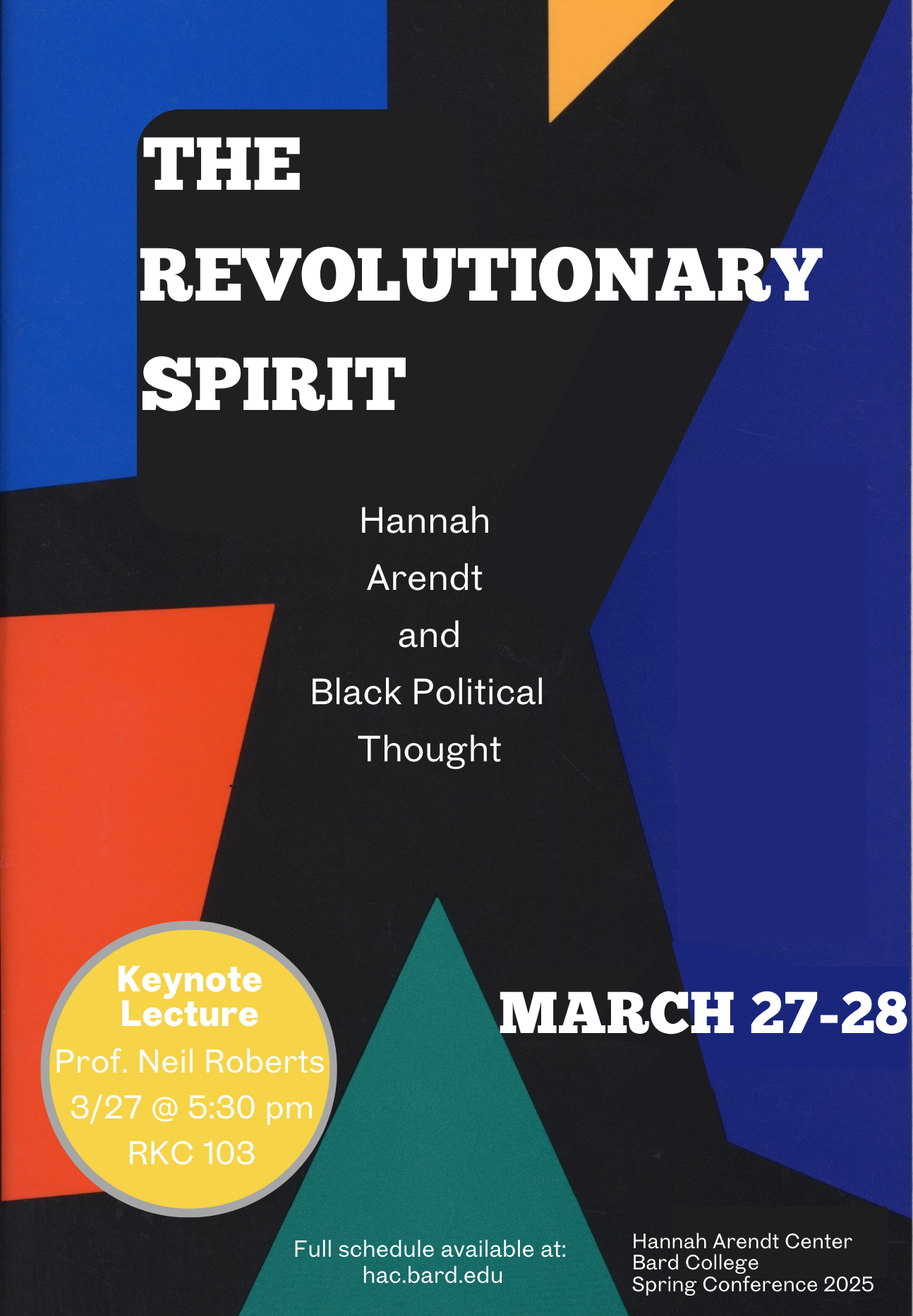
Together with Jana Schmidt (Bard College) and Miko Zeldes-Roth (University of Toronto), I am co-editing a volume with new and reprinted works investigating Arendt’s relationship to the idea of race and the ways that her work can illuminate the theory and practice of anti-racist politics. (This project partly came out of a conference I organized at Bard College, “The Revolutionary Spirit: Hannah Arendt and Black Political Thought”.) As political theorist Michael Hanchard has explained, Arendt “remains one of the few political theorists of any Western canon to explicate racism as a political phenomen[on]”. In Arendt’s work, we find the idea that race-thinking is born out of an “irresponsibility where nothing human could any longer exist,” and as such it is a threat to the idea of politics. Despite the unfortunate degree to which Arendt’s own thinking failed to thoroughly confront the problem of race-thinking, there is something in her notion of politics that requires the problematization of racism and race-thinking. The works in this volume read, analyze, make use of, and judge Arendt’s work to find in it something generative for the project of anti-racist political thinking.
‘…if we stood together’: The 1913 South African General Strike and the Making of Collective Power
This work in progress on M.K. Gandhi and his role at the head of a movement against the oppression of Indian migrants in South Africa considers another dimension of an alternative general strike tradition: the complexities of race and nation in a strike against colonial forces whose participants—some native and some immigrants from South Asia—are not seen as members of the nation. It also contributes to the recent discussions of Gandhi’s anti-colonial ethics and politics. I show how understanding Gandhi’s politics requires appreciating how members of the movement he led, against his protestations, undertook a general strike to improve their working and living conditions. Strikers challenged what they saw as Gandhi’s political purism and, at the same time, they refused intra-movement hierarchies across differences of race and gender. I argue that we can learn from those who, inspired by Gandhi’s vision, promoted the general strike as part of a radically egalitarian anti-colonial politics.
 J.L. Feldman